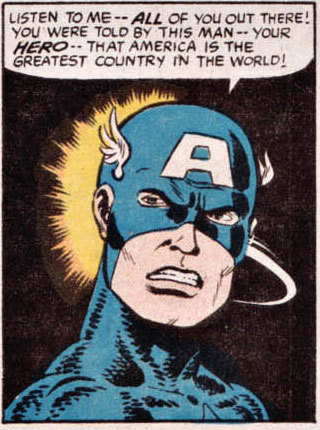
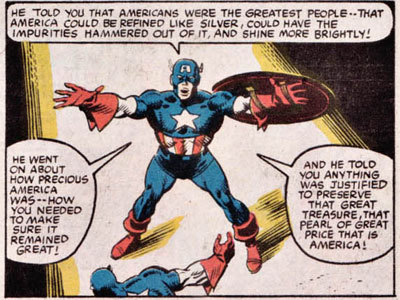
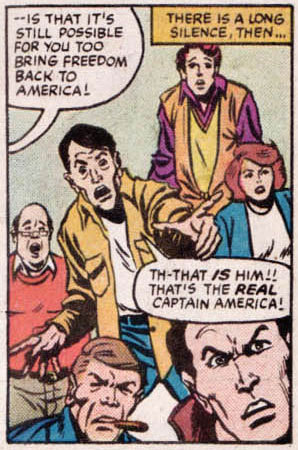
“Listen to me– all of you out there! You were told by this man– your hero– that America is the greatest country in the world! He told you that Americans were the greatest people– that America could be refined like silver, could have the impurities hammered out of it, and shine more brightly! He went on about how precious America was – how you needed to make sure it remained great! And he told you anything was justified to preserve that great treasure, that pearl of great price that is America!
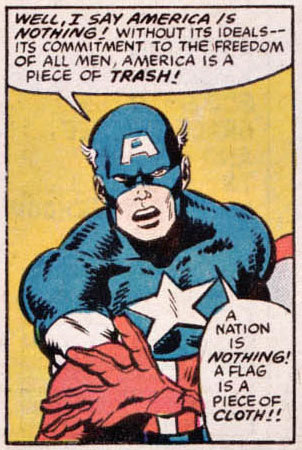
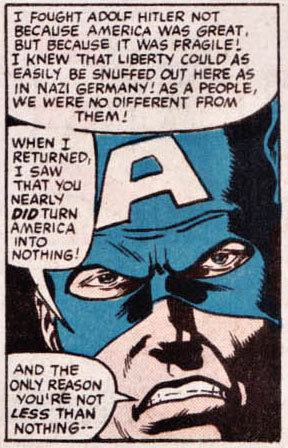
“Well, I say America is nothing! Without its ideals– its commitment to the freedom of all men, America is a piece of trash! A nation is nothing! A flag is a piece of cloth! I fought Adolf Hitler not because America was great, but because it was fragile! I knew that liberty could be snuffed out here as in Nazi Germany! As a people, we were no different than them! When I returned, I saw that you nearly did turn American into nothing! And the only reason you’re not less then nothing– is that it’s still possible for you to bring freedom back to America!”
I keep seeing annoying thinkpieces say that Cap was rejecting the very idea of external oversight of any kind, which— no he wasn’t?? Even remotely??
He
was basically saying that he wouldn’t be comfortable signing something
unless there was a system of checks and balances in place that would
prevent The Avengers from becoming “Winter Soldier Death Squad:
USA Edition”. (Yes, I know he didn’t know about the deathsquad at that point. But he’s done his homework on US military policy. His concerns are not unfounded.)
Remember what Bucky said about his former
co-workers? “Their most elite death squad. More kills than anyone in
HYDRA history, and that was before the serum. They speak 30 languages.
Can hide in plain sight. Infiltrate, assassinate, destabilize. They can
take a whole country down in one night, you’d never see them coming.”
Steve is asking for assurances that whatever governing body gains control of the
Avengers won’t decide to use THEM that way— and, in fact, won’t even
THINK of them that way. I think that’s part of why he becomes so furious
whenever people refer to Bucky, Wanda, Thor, and Bruce as “weapons”
instead of people. When you talk about a person as BEING a weapon, you
have taken the first step towards using them AS a weapon.
In
fact, in many ways, I feel like CACW was basically Watchmen: Redux, but
the version Zack Snyder refused to make. The central question is the
same: who watches the watchmen?
In Watchmen (book more than movie), the
answer is not “no one.” The answer is: different people/groups (and
yes, sometimes no one) at different periods throughout history. But
remember when the group watching the Watchmen was the US Government?
Because when the US Government was in charge, after the Keene Act (cough Sokovian Accords cough), the Watchmen had the
option of either retiring, or accepting orders to destabilize foreign
governments and commit mass slaughter, all in the name of “keeping
order”. AKA, literally what the Winter Soldier Deathsquad in CACW were
built for. Remember, Hydra’s #1 goal is “order”, but an authoritarian order that they
get to decide and enforce.
In CACW, I don’t see Steve saying
“The Avengers are perfect and no one can tell us what to doooooooo!” He
knows perfectly well that they are not infallible (see A:AoU). But he also
knows that on the ground and in the field, things go FUBAR and you have
to restrategize and do the best with what you have at the time. One of
Cap’s superpowers is his instinct for strategy in battle (clearly
serum-based, since pre-serum Steve Rogers’ favorite strategy was “spend
entire life running into brick walls both metaphorical and literal”). He
is asking: will the Accords allow him to use that power? Would he be
allowed to use his own judgment? Would the rest of his team? INCLUDING
Tony? When Tony flew the nuclear bomb up into the sky-hole way back in The Avengers, he was
essentially violating the will of the government agency that decided to
nuke NYC, because he saw a way to stop the invasion without causing the
deaths of millions. Would the policies of the Accords allow him to make
that decision (or a parallel one) in the future, or would he be arrested
and locked up for violating his “contract”?
I mean, sure, in the
midst of the initial discussion, Peggy dies, so Steve bails, and
then all the Bucky stalking starts up and Steve is all “I WILL BURN DOWN THE WORLD FOR
HIM, SEE IF I WON’T”, so the initial conflict gets ratcheted up about a
million times, but the central question of “who gets to be in charge of
these superpowered weirdos, and what does being in charge really mean”
still runs through the whole plot. It runs parallel to the question of
Bucky’s culpability. When you are turned into a weapon and used as a
weapon, are you to blame for the destruction that follows?
I keep seeing the conflict framed as this—
TONY: We need to be held accountable! CAP: No we don’t!
But I don’t see that at all in the actual movie. I see this—
TONY: We need to be held accountable! CAP: Accountable to whom? And what does being held accountable mean?
[feelings-based
punching breaks out, no one ever answers Cap’s implied question, Tony
himself finds out that being “held accountable” means being shoved into
the nautical oubliette where you get de-powered and possibly beaten for
the rest of your life, T’Challa proves that his government is the only one that should be trusted to be in charge of anything]
But the real reason I had to chime in was that Steve Rogers is my favorite superhero. Why? Because unlike other patriotism-themed characters, Steve Rogers doesn’t represent a genericized America but rather a very specific time and place – 1930’s New York City. We know he was born July 4, 1920 (not kidding about the 4th of July) to a working-class family of Irish Catholic immigrants who lived in New York’s Lower East Side.[1] This biographical detail has political meaning: given the era he was born in and his class and religious/ethnic background, there is no way in hell Steve Rogers didn’t grow up as a Democrat, and a New Deal Democrat at that, complete with a picture of FDR on the wall.
Steve Rogers grew up poor in the Great Depression, the son of a single mother who insisted he stayed in school despite the trend of the time (his father died when he was a child; in some versions, his father is a brave WWI veteran, in others an alcoholic, either or both of which would be appropriate given what happened to WWI veterans in the Great Depression) and then orphaned in his late teens when his mother died of TB.[2] And he came of age in New York City at a time when the New Deal was in full swing, Fiorello LaGuardia was mayor, the American Labor Party was a major force in city politics, labor unions were on the move, the Abraham Lincoln Brigade was organizing to fight fascism in Spain in the name of the Popular Front, and a militant anti-racist movement was growing that equated segregation at home with Nazism abroad that will eventually feed into the “Double V” campaign.
Then he became a fine arts student. To be an artist in New York City in the 1930s was to be surrounded by the “Cultural Front.” We’re talking the WPA Arts and Theater Projects, Diego Rivera painting socialist murals in Rockefeller Center, Orson Welles turning Julius Caesar into an anti-fascist play and running an all-black Macbeth and “The Cradle Will Rock,” Paul Robeson was a major star, and so on. You couldn’t really be an artist and have escaped left-wing politics. And if a poor kid like Steve Rogers was going to college as a fine arts student, odds are very good that he was going to the City College of New York at a time when an 80% Jewish student body is organizing student trade unions, anti-fascist rallies, and the “New York Intellectuals” were busily debating Trotskyism vs. Stalinism vs. Norman Thomas Socialism vs. the New Deal in the dining halls and study carrels.




 vvinterdumpling.home.blog