(my exam is over so i’m here to unload some angsty thoughts on the dash)
The one thing that’s been haunting me more than anything else is Bucky. Like, we all know that Bucky’s life has been severely lacking in peace and happiness since like 1943 –– but it didn’t quite hit me how badly until after Infinity War.
In every movie Bucky’s ever been in, we lose him by the end of the movie.
First Avenger is pretty obvious –– that Train Scene™. Civil War, not only is he an internationally wanted fugitive but he’s also going under yet again, because he feels like he doesn’t have a choice. Infinity War, he gets dusted or disintegrated or whatever-the-fuck that was.
The happiest ending he gets––and by extension, the happiest ending Steve/Bucky gets––is the end of Winter Soldier, where Bucky disappears yet again, but at least there’s the implied sense that he’s coming back to himself and rehabilitating. At least there’s hope.
In Civil War, Bucky said “It always ends in a fight.” And it breaks my heart how he’s proven right, again and again.
Every time he manages to build some peace and a slice of home for himself, the fight shows up at his doorstep and forces him back into it.
He’s buying plums and smiling and relearning himself in Bucharest when Zemo frames him for blowing up the damn UN and the entire world is looking to kill him again. He’s finally free of his trigger words (presumably) and living quietly in a little hut in Wakanda and learning to be comfortable without an arm when Thanos tries to kill half the universe and he has to get back out there again.
He might be tired of fighting, T’challa says, right before offering Bucky his new arm.
And he’s right. Bucky’s been tired of the fight since 1943, since he got off of Zola’s table. But Steve needed him, and then Hydra had him, and then the entire world was trying to arrest him, and then there was the possibility of rogue Winter Soldiers, and then there was Thanos and the end of half the damn universe.
He doesn’t ask if there’s a fight, if they need him, if the world’s ending again. He already knows. He doesn’t say that he doesn’t want to fight, because for all that he might be so goddamn tired of fighting for 70 years, he can’t walk away when someone needs him, even if that someone a world that’s tried to destroy him ten times over and never thanked him for saving it.
Where’s the fight, he says, because what else can he say? He can’t run away from the fight, because it always finds him again, no matter how much he doesn’t want it to. He gives up, because he’s never going to be free, and he’ll be fighting until the day he dies.
I think it’s a possibility. smarter, more observant people than me have worked out meta on this. A few weeks ago I saw a post about Bucky’s bruising/bleeding after Steve rescues him in ca:tfa
and how it compares to Winter Soldier in the chair:
It’s certainly a compelling argument. Whether or not they tested a rudimentary version of mind wiping technology on him, there’s a lot to be said for the way Bucky dresses before and after his capture. There’s a deliberateness to everything he wears, both from the directors/costumer designers in the movie to Bucky himself, because his clothing certainly does tell a story. There’s been fantastic meta on Bucky’s clothing, too. Let’s take a look at the Bucky we first meet:
what a dapper motherfucker. So pristine, and (mostly) to regulation with his tie and collar just so, with just a little bit of charm and personality shining through with the jaunty angle of his hat. This is why most people agree that Bucky Barnes cares about his appearance, that he cares about it so much that he used his hat to set himself apart.
The next time we see him before he’s captured is the deleted scene where he’s wearing his helmet. Again, it’s at an angle, but whereas the hat choice is deliberate, I would argue the helmet was donned rapidly. The fact that it isn’t buckled bothered me (like he was being cavalier with his safety/had to look good in the middle of a war zone) until I saw American Sniper, where there was a very similar moment where the sniper finished sniping and then moved to put his helmet on, very quickly with the emphasis on getting it on rather than fitting it properly, and I went ‘ooooh, that could explain it’. Bucky might need to get it on and off quickly so it isn’t obstructing his shooting. I’m sure there’s also a possibility both are for movie purposes too, blocking and face shots etc.
This is the last time we see something on his head until he’s in the mask as the Winter Soldier.
Let’s take a moment to compare Bucky before he’s shipped off, to Bucky post-capture.
First of all, no hat. Second, compare this to Bucky done up in full uniform from the first scenes. We’ve all read the fantastic meta that talks about his mental state in this scene, and I agree with that. This is a Bucky who can’t bring himself to wear his full regulation uniform.
But take a look.
what
other
similarity there is
Bucky no longer wears anything tight around his neck.
Bucky no longer wears anything tight around his neck.
And suddenly, his outfit in the bar scene becomes more of a focused, deliberate lack of regulation uniform. He literally cannot bring himself to do up his collar or tie, and it doesn’t get better.
His jacket is never done up fully, just tucked in. It LOOKS dapper as fuck, and I’m sure he’s aware he looks good in it, but if he picked it out himself as we enjoy speculating, he also picked something he’d be warm in but could also get it away from his neck with a quick tug. Is this so he can breathe easier? Is it because he actually had something around his head and neck while tortured? We could get into the possibilities indefinitely.
brb crying over Bucky again
I just want to add that every scene we see him in after the rescue, he’s holding something he can use as a weapon. On the battlefield, it’s the guns. Specifically the big one he has taken to carrying like a baby, which I have no doubt he intends to use on Zola next time he sees him (he seems the poetic type to kill Zola with a gun taken from the place that tried to destroy him). In the bar, it’s the glass, which he only lets go of when Steve is present. He doesn’t want to ever be in a situation where he is bound down and shackled like an animal again, so he takes pains to make it as difficult as possible for anyone to get to him that way again.
Ye gods, this is perfect. And he’s so low-key about it that even though we see Steve carefully taking in the state of Bucky’s dapper uniform in the alley (“You get your orders?”), he spends very little time checking Bucky over once they’re away from the factory. Even in the bar scene, if I remember right, Bucky looks at Steve WAY more than Steve looks at Bucky. Steve doesn’t feel the need to examine Bucky closely—he’s always busy with something else—even as Bucky keeps his laser-focus on Steve.
Bucky slipped the extent of his trauma right past his best friend. Steve doesn’t seem to have any idea how fragile Bucky is, even though Bucky’s practically hanging a neon sign on it with these wardrobe changes.
(I’m so sorry I erased the original post I’M SO SORRY! You can read this without the visual aids on AO3.)
March 10, 1917 – James Buchanan Barnes is born, and we were all officially fucked.
July 4, 1918 – Steven Grant Rogers is born, and somewhere in Brooklyn Bucky’s mother wept …
June, 1924 – Steve’s mother is bedridden from illness associated with Tuberculosis.
September, 1930 – 12-year old Steve and 13-year old Bucky meet for the first time in Hell’s Kitchen, where Bucky scares off bullies trying to steal Steve’s money. What were they doing in Hell’s Kitchen? No one knows. Steve tells Bucky he’s been living in the orphanage ‘on 8th’ since his mother’s death. Which is odd since Bucky was apparently at her funeral when they’re both legal adults in a flashback scene from the Winter Soldier. For the purpose of this timeline, info from the movies will take precedent over info from the various tie-ins. Meaning Sarah Rogers is basically Schrödinger’s Ma for the next 6 years.
The Howling Commandos probably made the history books post WW2.
A little black boy probably read about Gabe Jones at some point.
An African American soldier. Not just any soldier, a Howling Fucking Commando. Handpicked by Captain America. Who received an education at Howard University. A man who became a charter member of SHIELD.
All before 1950.
That little black boy probably wanted to be like Gabe Jones when he grew up. He probably served in the military. He probably climbed through the hierarchy of the Strategic Homeland Intervention, Enforcement, and Logistics Division.
Reading about Gabe Jones probably completely influenced that little black boy’s life.
Sam Jackson was born in 1948. His involvement in the Civil Rights movement warrants it’s own section on his wiki page.
Don’t tell me that if MCU Nick Fury is the same age as the actor portraying him, that he didn’t look up to Gabe Jones growing up. Don’t tell me that reading about Gave Jones didn’t inform his decisions of what to do with his own life.
No wonder Triplett didn’t want special treatment. Not only was his grandfather a Howling Commando, but if it weren’t for his grandfather Nick Fury might not have joined SHIELD. HYDRA probably would have succeeded in their coup and Project Insight, that is, if they were still around. Might not have been. Without Fury, would there have been any Avengers Initiative? Would Loki rule Midgard?
Just think for a moment. Just think about that the MCU as we know it probably exists due to the impact Gabe Jones had upon it. How he influenced others, and what those others did with their own lives.
[This was part of a larger national survey of several thousand families, and the Dept of Home Ec was at the time part of the Department of Agriculture. So far as I can tell, the Dept asked families to keep a very detailed diary of expenses for two weeks, and then did a couple of intensive follow-up interviews in person. Most of the families in this set were nuclear married couple families, so there is some limitations for applying this to two men living together or alone.]
First, some basic numbers: I’ve done a couple posts already about income/rent/occupation/birthplace/etc in different Brooklyn neighborhoods, and if you want to play around with any of that data, you can see it here. But the tldr is the most likely occupation for a young working class man in 1930s Brooklyn would be, in order: file clerk/bookkeeping office work; unskilled factory work; and retail sales, making 50-70 dollars a month with rent about $25-30 a month. (You can see and play with the housing data here).
Obviously how an individual household distributed its expenses differed depending on what the household looked like, unemployment, if they were giving money to family, etc etc, but for 1935-1940, the Dept of Home Economics estimated the average distribution of expenses for working-class families in Brooklyn and NYC:
The Dept of Home Economics said that for a family of 4, a working class monthly income of $125 a month was "not so liberal as that for a ‘health and decency’ level which the skilled worker may hope to obtain, but it affords more than ‘minimum of subsistence’ living.“ My interpretation of this from working with other Dept of Home Ec records of the period is that this is slightly above what we would call poverty-level now, and more like lower middle class or working poor. Not so much that there’s much room for savings or for emergencies, but enough to make ends meet. The Dept of Home Ec said that their working-class minimum included: “The housing allowed is a 4- or 5-room house or apartment in a fair state of repair, with an indoor bath and toilet for the family’s exclusive use. The budget includes maintenance for an inexpensive radio, a daily newspaper, and attendance at the movies once a week. It does not provide an automobile. No provision is made for saving other than life-insurance premiums.” A family of 4 on $125 would be just getting by; 2 people living together would have been doing pretty ok if both were working full time and had no periods of unemployment or expensive emergencies. The Dept of Home Ec said that a monthly income of $210/month for a family of 4 would be a much more comfortable rate which would allow for some savings, leisure travel, a car, nice consumer goods and school tuition.
I have the numbers for distribution of food expenses, but I haven’t run them yet (I can if anyone is super interested). Food prices in Brooklyn in 1940:
Beef starting at 25 cents/lb for a roast and going up from there
Bacon 30 cents/lb
Cheapest meat available: salt port at 17 cents/lb or fresh fish at 16 cents/lb
Milk delivered quarts by the milkman: 13 cents a quart, or 52 cents for a gallon jug
Eggs 35 cents/lb
Fresh fruits and vegetables including potatoes: 2-7 cents/lb, with the exception of oranges at 27 cents/lb. Bananas were pretty affordable at 7 cents/lb.
Canned fruit and veg: slightly more expensive at 10-20 cents/can
Coffee: 20 cents/lb
If you want to see what how these numbers compare to 2015 dollars, the Beareau of Labor Statistics has a calculator here, but my check of the comparisons is that most prices seem to be roughly as expensive as they are in 2015 terms, with the exception of milk having been much more expensive at an adjusted 2015 $8/gallon and coffee having been much less expensive at an adjusted 2015 $3.50. (Milk is $4 and coffee is $8-12 in my area).
Other kinds of expenses:
Funerals: For families who buried someone in the past year, the average cost for the funeral was $70, which seems quite low to me considering the average monthly rent was around $35 or so. Meaning that a funeral was about two month’s rent, which my gut says is too low, but that’s all I have data for. At least according to the MCU phase one bonus materials, Steve’s mother died when he was 18 in 1936, putting her right in this average. Though the funeral costs ranged from 30-140 dollars, so again, unclear what the actual cost of the funeral would have been.
Medical care: Most working class families in the set saw the doctor 1-2 times a year, about equally likely to see the doctor in a clinic, office, or home visit, with a cost of about a dollar a visit. The Dept of Labor’s cost-of-living calculator says that’s about $17 in 2015 money, but relatively speaking I think it would have been the equivalent of closer to $50—it’s about ten beers worth, or a little on the high side of a copay for people who have insurance now. So kind of a big expense, especially if you’re seeing the doctor a lot. Most families spent around fifty cents to a dollar a month on medicines, including non prescription things like aspirin and cough syrup as well as prescriptions.
Public transportation and cars: only about 20% of families owned a car, and for those that did, Chevys, Fords and Pontiacs were the most popular across all occupation groups. Families that did own a car spent about 20 cents per person per week on public transportation including buses, streetcars, and subway lines, and families without cars spent about 30 cents per person per week. Unskilled and lower wage workers (docks, laborers, factory work) spent more on average on public transportation, probably because they lived farther from their jobs. @hansbekhart has a great post on the subway/streetcar system and costs.
Entertainment: The average working class man in this set spent $3 a year on baseball games (and other sports, but lbr it’s probably mostly baseball). I haven’t been able to find out how much tickets in the cheap seats cost, but if it’s anything like a movie ticket (25 cents), that’s 12 games a year. Likewise, the average working class man saw a lot of movies–12-20 movies per year! Children saw more! That’s more than one movie a month, at a cost of 25 cents a movie.
Other fun things: The average working class man in this set bought 2-5 packs of cigarettes a week. That seems like a lot to me! But I don’t smoke. Almost all men in this set reported buying at least one pack of cigarettes a week (with the exception of life insurance agents!). Likewise, almost all men reported having at least one beer a week, with the average being 3-5 beers a week at home and 2-3 beers a week outside the home, at a cost of ten cents a pint/bottle for both.
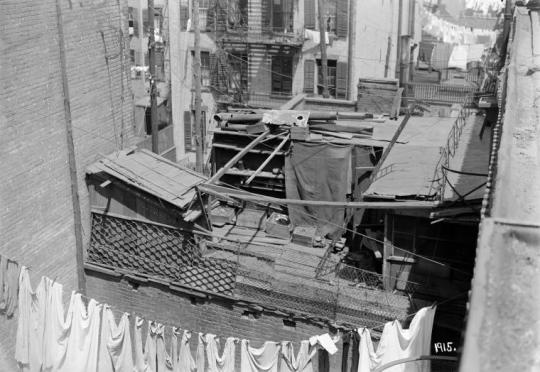
Clothes: Working class families spent around 10% of their income on clothing and related expenses, but there’s a lot of variety in this depending on how many people were in the family, so it’s hard to say how much exactly Steve and/or Bucky would have spent. My best guess based on the data: A single man, making around 50-70 dollars a month, would have put about 2-5 dollars of that towards clothes, haircuts, things like that. A man’s suit cost in the 10-40 dollar range, and the Dept of Home Ec said that about 50% of the working class men in their sample bought suits in the $17-27 range (a suit including pants, coat and vest), preferring suits in the $22-27 range. So for someone paying $30 in rent, a suit would be a pretty big deal, but in making the choice they would tend to prefer the more expensive option in their price range. Working class families also spent around a quarter a week on laundry expenses, mostly on putting laundry out to wash instead of doing it themselves. So a family would send their laundry out to a laundress who would wash it by hand, and then get back the wet laundry to hang dry themselves.
This is the stuff I was interested in, but the dataset is really big and pretty fine-detailed, so if there’s something else you want to know about, let me know!
I want to do something like this in future (I have a working document on grocery prices in my Google Docs.) but it a big project. In the mean time, this post is amazing and goes into things I probably won’t anytime soon!
like, you can see how the WS outfit is like, a twisted version of the original, that allegory is pretty clear. not much to go into there, except the insignia of the Howling Commandos -which represents his freedom (escaping and going onto fight with other men who escaped), and his strength to be able to not just go back to fighting the war, but basically joining a Hydra Hunting party and directly going after the people who fuckin tortured him, putting himself at risk of being caught again- thats stripped off, and in its ‘place’ a Russian star that unlike the wings he proudly wore, a was brand of ownership.
the third, hes got no idea who he is, his clothes reflect neither…except the strapped backpack that references the WS outfit, because that bag is full of journals of things he remembers. hes literally carrying the weight of the Winter Soldier on his back.
4th has like…minimalist lines, the FA looking collar, the zipper a bit off center but still black and shit.
because here, according to the Russos, he remembers everything. hes got two sets of memories. the memories of a guy hes not sure he deserves to be, or can be anymore…and the memories of something he never wants to be again. but can he fight as just Bucky? does he need to be more Winter Soldier like to make it through the fight? so you have an outfit referencing each, but very vaguely, because he doesn’t know which he is, if hes even either one of them
annnd then we get IW. dark blue, very pronounced lines on the front doing up at the side, brown pants. the same colors as the original outfit, though still a lot darker. like hes figured out which one he is, he’s Bucky. but he can never 100% go back to his old self, part of him will always have been the Winter Soldier. so it looks so close to his original outfit, but still with hints of the WS in it. and the three lines on the pants feels a lot like the a reference to
you can literally follow his character arc through his clothes its awesome
“I think for Steve, it’s just so important for him to contribute something. He doesn’t want to be in the shadows. Bucky in this version has always looked out for him and been very overprotective. He’s had Steve in his mind in a certain way. He’d never want anything to happen to him—he’s the only family he’s ever had. […] I think for him there’s an element of, “Okay I’m going to go fight and I will survive this one mission and then I’ll come back and I’ll not go back.” But the problem is that he has no choice because Steve’s going and he never lets Steve go by himself. […] Bucky’s like, “It’s you and I care about you—of course I love you.” – Sebastian Stan [x]
I’ve been thinking about Bucky’s robot arm a lot (hi have we met), so I figured I might as well collect all my thoughts in one place, since they might be interesting/useful to other people. I organized this as a q&a, but obviously these are just my answers based on what we’ve seen in the MCU. I’d be really interested in what other people think, or if anyone has other questions they want me to speculate on.
Do you think he just looked at Shuri and said, deadpan… Blue.
Like any good nerd, I think that Shuri did her research (after posting a few embarassing videos of T’Challa of course). When it came time to design something for ‘Bucky’ to wear, she began by looking at what he’s worn in the past. Until proven otherwise, I’m giving her full credit for combining elements from each of his uniforms to create something new because it feels completely in-character.
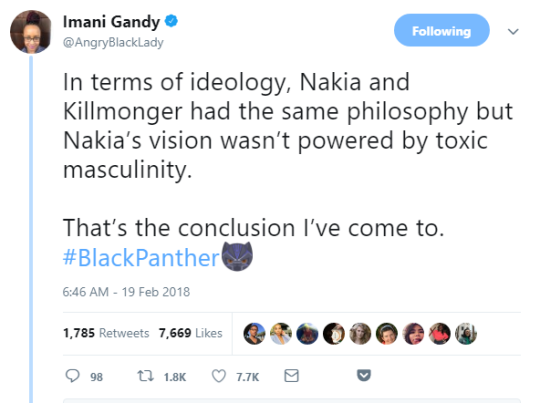
I don’t understand how you can see Killmonger disrespect culture, attack women, basically was trained by military to tear down civilizations, his own father says he is disappointed in what he’s done, move to arm black people outside of Wakanda with high tech weapons (yes cuz giving Leroy and em cannon blasters is gonna help the cause) and y’all still fix ya lips to say he was right lol when Nakia exists. Wild.
I was waiting for someone to say this.
There’s a reason he was the villain. He killed his girlfriend in cold blood. His anger was understandable, true, but his methods abhorrent and destructive. The end result would have been huge amounts of death and chaos. No positive outcome.
[Killmonger was an amazingly written villain and a great, if not perfect, example of how to execute a “tragic backstory villain arc”. Due to his characters anger and Michael’s incredible acting it made Killmonger a character a large amount of people could empathize with. An amazing villain. Truly.]
Nakia LITERALLY was team “let’s stop having Wakanda be an isolationist nation and help the worlds oppressed” from the jump and she doesn’t get enough credit.
I love Killmonger, he was a great villain, and while I sympathize with him, I did not want him to win.
(honestly, I think that’s why the girlfriend scene was in there. She was, essentially, the puppy he was supposed to kick so we knew he was The Bad Guy… and yet, people seem to value puppies more than women.)