A comment mentioned Bucky’s pants thinking I’d talked about his uniform. I haven’t, but I know I’ve reblogged a Tumblr post about Bucky’s uniform. Fortunately (or unfortunately depending on your opinion of time management skills??) I can expound on the information that’s already out there. I also cannot for the life of me FIND that Tumblr post to link it, but I’ll keep working on that.HA Fuck you, I found the post!
I’m not going to get into Army issue. That information is, frankly, kind of easy to find if you need it and Bucky spent none of his post-WTFSteve?? period wearing Army issue. I’m going to try to parse his Howling Commando uniform.
Can we just talk about the moment when the Howling Commandos realize that the only reason any of them made it out is because Steve loves Bucky That. Fucking. Much.? That if Sergeant James Buchanan Barnes were just a tiny bit less adorable, they’d all be dead?
I’m certain that the 107th being captured wasn’t the first tragedy Steve heard about in the war, probably not even the first group he’d heard about being captured. If the 107th hadn’t had Bucky in it, I think he would have definitely wanted to help, even asked Phillips about it, because Steve is a good man, of course. But Phillips would have told him just the same, he wasn’t enough, he was a chorus girl, a dancing monkey. And Steve would have believed him. After all, what was he supposed to do, take on an entire Hydra factory by himself? He was just one man, even if he was strong. He’d get himself killed for nothing and never see Bucky again. Because at this point Steve wouldn’t have had the opportunity to test himself at all. He didn’t know what he was capable of. If the 107th was any other unit, Steve would have allowed Phillips to cow him, because it would be easy for him to believe. Steve was obviously not brimming with self confidence at this point, of course, a lifetime of being told he was not enough doesn’t go away just because he got all jacked in the hotness microwave. It was crazy, to think he could do anything. But the thing is, of course, that Steve is crazy for Bucky. Absolutely fucking bonkers. Did he think he was really going to go in there and save Bucky and not just die horribly? Of course not, he was probably 99% sure that he was gonna get his insides turned into outsides. But that 1% was more than enough. It didn’t matter how crazy, it was Bucky, there was no other choice. Because Steve is absolutely out of his mind for Bucky. He’d fight all of Germany for Bucky, win the war on his own, punch God himself right in the face for Bucky. It didn’t even matter that he was a superman now, if skinny Steve was somehow over in Germany and he heard about Bucky he’d have done the exact same thing, guaranteed, because he’s insane.
The day the Howlies realize this is probably very sobering. They were saved because mere chance put in their unit the one guy who had someone out there who loved him enough to storm a Hydra factory by himself, and the ability and sheer willpower to actually succeed.
“he got all jacked in the hotness microwave“
I love it. I will never not think of it this way again. (Also, A+ addition to my very old post.)
GOSH I LOVE GETTING QUESTIONS LIKE THIS BLESS YOU.
I think in the particular case of the Howling Commandos this question would have an awful lot to do with what exactly their duties were, where their missions took them, and for how long. We don’t really get much of a sense of it in The First Avenger, and honestly I think you can do this in a lot of different ways and sort of lean in whatever direction is convenient for the plot. (I’m working on a Howlies-era story now and that’s exactly what I’m doing. Need privacy for a threesome? Oh how convenient you’re holed up in a perfectly suitable location for ~*~mission related reasons!~*~) I’d think it would be fairly situational depending on things like exactly how filthy they are (like if they remain unwashed is it going to compromise their ability to do their job or impact them physically like with hypothermia? Are they going to be unable to sneak up on the enemy because they are way too fucking rank and they crinkle when they walk? Is Sgt. Barnes going to get into a fight with anybody else in the unit because they’re all sick of him complaining about how bad his hair looks?), how far from a base they are, that sort of thing.
In the field, I’d imagine they’d do whatever worked. Bear in mind that a lot of the fighting in WWII was ranging through populated or recently-populated areas; depending on where they were, it might not be too difficult to find a well, a rainwater barrel, a pump for a livestock trough, or some other handy water access that might allow a fella to clean up some. And there are plenty of actual houses and whatnot with actual bathtubs, I’d imagine, though hanging around an area with townsfolk or other unknown quantities around might not be worth the risk of getting shot. But they could also just as easily be moving through an area where everything’s been bombed to shit, every splash of water in a 10-mile radius is choked with waste and decomposition, and even if it’s been raining for a week the word “clean” is no longer their vocabulary.
For regular soldiers, they’d be occasionally rotated back to camp where they’d be able to get in a wash, a delousing, some square meals, maybe some R&R, before they had to head back to the front. Once they were out there, availability of any kind of personal grooming would’ve depended a lot on whether having a wash would get you shot. A lot of times they’d be washing just out of a bowl or helmet, or not at all if the available water was all needed for drinking. Shaving was more or less mandatory (considered part of the uniform, basically), but when you’re in the field awhile it all depends on what you have the time and resources to do. And the Commandos aren’t a regular unit, anyway. I’d guess their war experience was unconventional to say the least.
In camp, things would be a bit easier. Laundry would be handled by the Quartermaster Corps (these are also the supply folks who’d be handling whatever other stuff you needed issued, they basically keep the armed forces fed, clothed, and supplied; they handle logistical concerns of all kinds). They’d have a trailer with the necessary equipment, which is interestingly enough how these units still operate today, just a lot fancier. This page about the Quartermaster service has some super interesting information on these laundry units operating in WWII in Europe and through other US military conflicts. If the clothing was really destroyed, it’d probably be replaced, though it’s hard to imagine the Howlies allowing that since most of them had decidedly non-regulation uniforms. (Plz write me a story about Sgt. Barnes and how fussy he is over his sweet blue coat and what he keeps tucked carefully in the inside pockets and whether his button-sewing skills are the best in the unit and that time in Poland when he somehow sweet-talked a grandmother into helping him wash his coat because he loves it tooooo much. Bonus points if the grandmother gives him amazing tips on how to get blood stains out and they somehow bond despite the fact that Barnes doesn’t speak a word of Polish.)
This page has some recollections you might find informative (I like in the comments where he complains about his “nice Yankee shirt” being cut off him because it was soaked in blood), and you might find the entire WW2 People’s War archive interesting; it’s all first-hand accounts of people’s experiences during wartime, whether they were on the home front or elsewhere. (There are 47,000 personal accounts on there, holy shittttt.) You might be particularly interested in this story about a group of soldiers rigging up a huge horse water trough into a communal bathtub for a nice hot scrubbing. 😀
As you might imagine, sanitation is a pretty big deal in the field, and just like all militaries struggled to keep their soldiers from taking themselves out of the fight with things like venereal disease, they also wanted to prevent other hygiene-related problems that would impact troop readiness. We’d think of stuff like foot fungus or lice as a fairly minor but totally gross issue; in that period, in the war, if your troops had lice you were going to have a problem with typhus, and that’ll straight-up kill them. This link has a whole book chapter about the sort of procedures and training the Army had in place for troop hygiene, both the intro to personal sanitation that they’d receive in boot camp (they’d be shown “Mickey Mouse movies” I wonder if they literally had Mickey Mouse in them) and the ongoing drumming in of the message as they were shipped out to different theaters in the war.
Personally I like to imagine a Bucky who was once fastidious and tremendously well-groomed and has left all that behind because if war has changed anybody it has definitely changed him, only one day he loses his goddamned mind and they’re going to cross this nice slow-moving river and it’s kind of turning into a warm, bewilderingly beautiful day, and Barnes just puts his gun down and kicks off his boots and everybody’s like “oh shit Sarge has lost it” and he just walks into the river fully clothed and everybody’s like “Hey Barnes what’re you doing?” and he’s just like “My laundry. Fuck off.”
And he just like crouches down in the river so his nose is above water and he just stays there because he stinks and he’s incredibly tired of it, okay.
And maybe Captain America himself puts down his shield and his gun belt and wades in to drag his damn fool sergeant out of the river because what the hell, Buck, this area isn’t exactly cleared, there could be snipers, you idiot. And maybe Sgt. Barnes does or does not dunk the symbol of American freedom and give him a noogie.
let me preface this by saying that i’m not a legal scholar by any means, but the sokovia accords are a beefed-up version of the civil liberties violations raised in rumsfeld v. padilla (2004) and in the post-9/11 era, and this follows the thematic issue raised in the civil war comics, which were published around the same time as the ruling on the padilla case.
the accords are very much meant to be blatant reflections of modern laws and policies that allow the violation of the civil liberties and civil rights of all citizens, and combined with the themes of surveillance, preemptive strikes, and violation of rights, liberties, and agency in cap2, steve’s opposition to the accords are in line with the russos’ theme for his character: i.e., a captain america who stands in opposition to the post-9/11 right-wing expansion of power for the sake of “security,” at the cost of the liberties, rights, safety, and humanity of its (often most vulnerable) citizens.
Do you ever sit around and think about how Captain America: The First Avenger is aptly named not because Steve Rogers was the world’s first superhero (and future leader of the Avengers Initiative team) but because one of his most memorable acts of bravery – crashing the plane to save the world – was done in the process of avenging Bucky Barnes.
okay but in all seriousness i bet it’s a real hazard to cry or even sit on your bed looking unhappy at Avengers Tower because Steve “Mom At The Ready” Rogers WILL appear in your doorway wearing something soft and saying “Hey.” in a gentle, compassionate voice
I want to point out that in CATFA Bucky never spoke about being tortured at Kreischberg and Steve never pursued the conversation although he saw, with his own eyes, the sort of environment he was in (if not the torture itself).
Assuming they didn’t talk off-screen, maybe Steve felt too awkward to bring it up, or Bucky deflected the question and acted like nothing was wrong. Maybe Steve was too distracted with the war; maybe Steve was too distracted by his own dreams coming true to notice Bucky’s admittedly very subtle signs of distress. Maybe Steve thought that Bucky getting his chance at revenge as part of the Commandos would be enough. Maybe all of the above.
Do you suppose that after Bucky fell from the train that Steve, intensely guilt-ridden and ready to think the worst of himself, especially in light of his relationship with Bucky, castigated himself for not being a better friend? Did he look back on all their interactions with a hypercritical eye, and pick himself apart for not being observant enough, not being considerate enough, not being emotionally brave enough to pursue these difficult topics?
Do you suppose that mere decades and weeks later, Steve had excoriated himself enough to seek out Tony, a man he doesn’t like and who doesn’t like him, after Coulson’s death, to try to comfort him, in his clumsy, war-mindset way? And when Tony didn’t respond positively (“We are not soldiers”), maybe he did some digging, found a way to modify his approach, so that when he assumes Natasha would be in distress about SHIELD, he approaches her in a way that’s less…bossy, perhaps? more inclined to listen first and make assertions later. And then comes Wanda who, for all intents and purposes Steve seems to have adopted as a little sister, and he modifies his approach again to still be soft but a little more authoritative; more of a big brother/father figure approach (since she is much younger than Natasha and is still visibly reeling from the loss of her own father and brother).
Steve has always been good and compassionate towards the whole world as a concept, but he started out very much up his own ass with regards to how much consideration he put into his interpersonal relationships, and seeing him mature in that respect is both beautiful and heartbreaking.
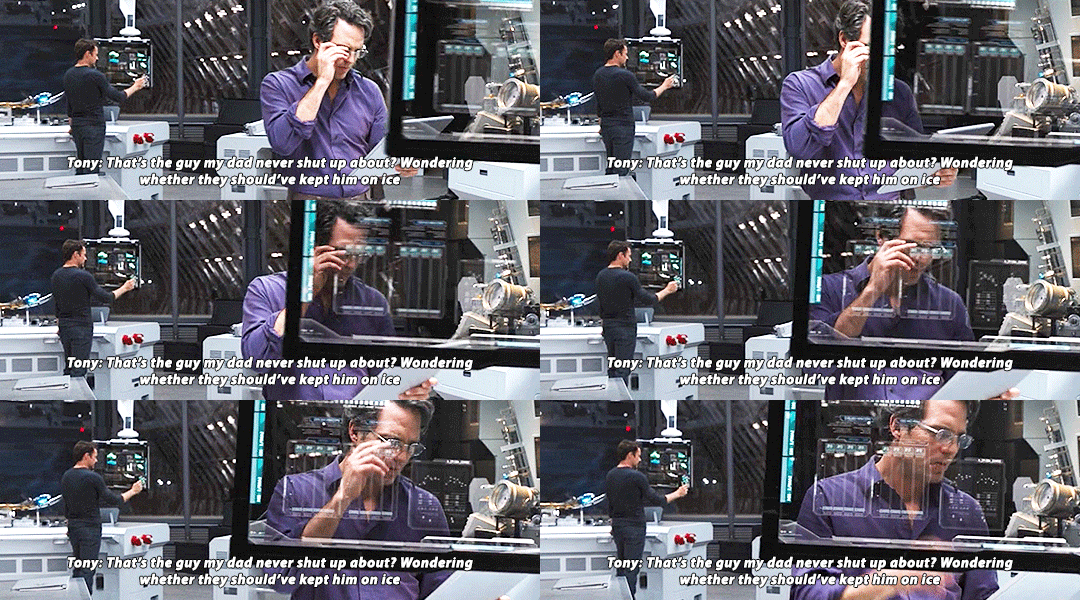
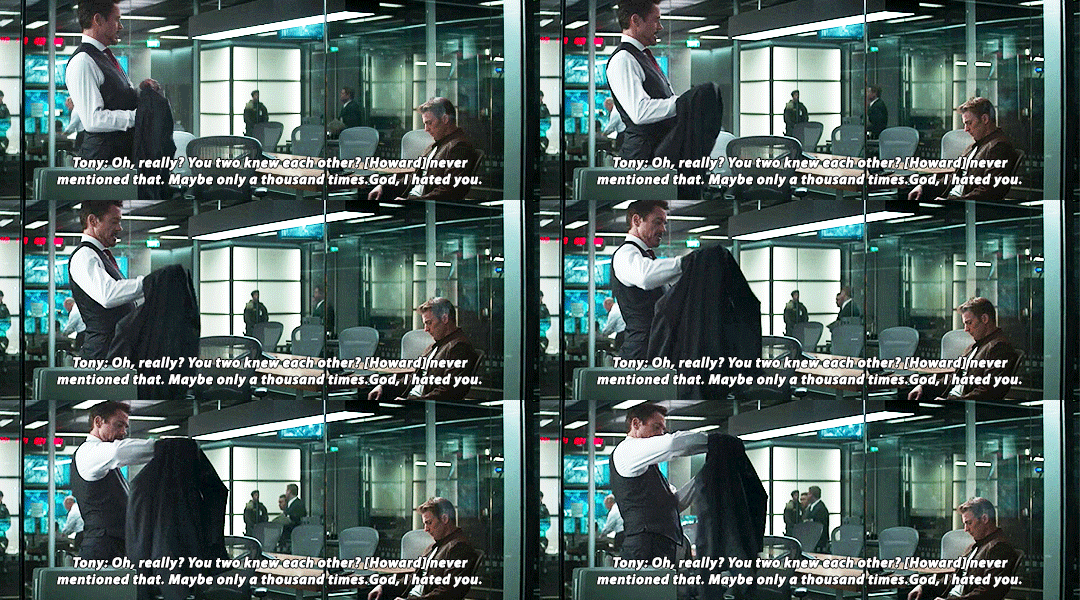
The relationship between Tony and Howard Stark feat. Steve Rogers.
Bonus:
One of the things that never fails to PISS ME OFF about MCU fandom is how nobody ever addresses how fucking UNFAIR all of this is to Steve himself!
Steve didn’t make Howard act like a douchewad; Steve didn’t seduce him, or court his favor, or do anything to try and get Howard to put him onto such a high pedestal that Tony would spend legitimate effort trying to knock Steve off it every time he’s in an insecure mood.
No, Steve fought a war, in the best way he knew how, and if that included dying, then fine, it included dying. He doesn’t deserve Tony whacking him over the head with Howard’s failings as a dad every time he turns around. That was never Steve’s fault, but Tony never lets him forget about it either.
As a parent I get especially angry about this. Because by pinning blame on Steve, who is 100% without fault in this scenario, they’re excusing Howard’s shitty parenting and culpability. And that’s disturbing.
Steve is not responsible for Howard’s issues.
…The only one responsible for Howard’s issues was Howard.
If one truly believes in accountability and they want to be accountable for their actions, then part of accountability is not creating or accepting excuses.
Not only isn’t Steve responsible for Howard’s behavior and Howard’s weird Steve fixation, Steve isn’t AWARE of it. Steve comes out of the ice remembering Howard as merely a friend. For Steve all of Tony’s resentment and hostility comes out of left field.
Maybe Tony telling Steve he grew up hating Steve at least was the dawning of understanding.
This fan identified the food Bucky kept in his apartment.
@steve-rogers-new-york, it is interesting comparing these foods those pre-war Bucky would have known.
<p> @missjanedoeeyes, oatmeal and plums would have been a hearty breakfast.
I don’t think it would be a stretch to think that the products that Bucky would pick to have in his Bucharest apartment would be ones that were either familiar to him, or in his taste. Below are some equivalent products that Bucky (and Steve) would have known in the 1930s and early 1940s — including brands advertised in period editions of the local Brooklyn newspaper, the Brooklyn Daily Eagle, along with their advertised costs (when available).
Kolln White Oats These are a popular German brand of instant oats, typically used in making oatmeal.
“White oats” is another name for ground oats. Both regular and instant oats were common in 1920s-1940s North America, used not only to make oatmeal, but also in baking and to stretch meals like meatloaf during wartime rationing.
Oats Common Brands and Costs: Quaker Oats Quick/Regular (20 oz. pkg. 10c), H. O. Quick/Regular Oats (16 oz. pkg. 11c), H. O. Old Fashioned Oats (16 oz. pkg. 10c / 32 oz. pkg. 18c) Ralston Quick (16 oz. pkg. 20c), Ralston Regular (28 oz. pkg. 21c), Ralston Instant (16 oz. pkg. 20c), Morning Glory Rolled Oats (20 oz. pkg. 9c / Large pkg. 20c), Sunnyfield Rolled Oats (20 oz. pkg. 8c).
Other Cereals During the 1930-1940s there were also a wide range of other breakfast cereals available to customers. Many of these can still be found in 21st century supermarkets. Common Brands and Costs: Kelloggs: Corn Flakes (6 oz. 5c), Krumbles (9 oz. 11c), Wheat Krispies (8 oz. 12c), Pep (8 oz. 10c), Shredded Wheat (Large 11c), Bran Flakes (8 oz. 10c). Post: Bran Flakes (Large 14c / Small 10c), Grape Nuts (14c), Grapenut Flakes (Large 14c / Small 10c), Grapenut Wheat Meal (13c), Toasties (11 oz. 9c / 6 oz. 5c). Battle Creek: Bran and Figs (12c). Quaker: Crackle (9c), Puffed Rice (11c), Puffed Wheat (10c). River: Puffed White/Brown Rice (7c), Puffed Wheat (6c). Wheaties (8 oz. 11c). H. O.: Force (8 oz. 11c). Sunnyfield: Assorted Cereals (8 ½ oz. 20c), Bran Flakes (8 oz. 7c), Corn Flakes (8 oz. 5c / 11 oz. 7c), Wheat Flakes (8 oz. 8c), Rice Puffs (4 ½ oz. 5c / 8 oz. 10c), Wheat Puffs (4 oz. 4c / 8 oz. 8c), Rice Gems (5 ½ oz. 9c).
Almdudler Soda Original This drink is a popular Austrian carbonated soda drink, in fact it is referred to as the “national drink of Austria”. It is made from apple and grape juice concentrates with added herbal extracts — commonly likened to ginger ale, but with a richer flavour.
Going on this taste — and one could assume based on the fact he has some that Bucky likes the taste — the closest equivalent in Steve and Bucky’s New York would be a ginger ale, or possible a birch beer, root beer, or sarsaparilla.
Ginger Ale This was a popular and common drink in 1930s-1940s America. It can be found in many supermarket and magazine advertisement from the period. It is a carbonated ginger based drink (obviously), with a mixture of spices and fruit flavours (often lemon and lime — occasionally pineapple and honey). Common Brands and Costs: Canada Pale Dry (29 oz. bottle 15c), Hoffman’s Pale Dry (29 oz. bottle 15c), Hoffman’s Amber (29 oz. bottle 15c), Schneider’s Pale Dry (3 28oz. bottles for 25c), Bohack Pale Dry (4 Pt. Bottles for 25c), Seely’s Pale Dry (29 oz. bottle 20c), Golden (29 oz. bottle 20c), Yukon Club (12 oz. bottle 10c), Clicquot Club (12 oz. bottle 14c), C&C (12 oz. bottle 15c), Red Star ($1.64 p/doz.)
Birch Beer Birch beer has a similar taste to ginger ale. It is made from (usually) birch bark and sap, with other herbal extracts. Common Brands and Costs: Red Star (15 ½ oz. bottles $1.64 p/doz.), Hoffman’s (29 oz. bottle 15c)
Root Beer This drink does not appear to have any standard recipe but common ingredients range from vanilla, cherry tree bark/sweet birth bark, licorices root/anise, sarsaparilla root, molasses, and honey. Common Brands and Costs: Hire’s Root Beer (6 12oz. Bottles for 25c), Red Star (15 ½ oz. bottles $1.64 p/doz.), Hoffman’s (29 oz. bottle 15c), Seely’s (29 oz. Bottle 20c).
Sarsaparilla Sometimes considered a type of root beer. North American sarsaparilla is not classically made from sarsaparilla plant extract, but from a blend of birch oil and the dried root of the sassafras tree. Common Brands and Costs: Red Star (15 ½ oz. bottles $1.64 p/doz.), Hoffman’s (29 oz. bottle 15c), Seely’s (29 oz. Bottle 20c).
Funny Frisch Chipsfrisch Gesalzen These are a German brand of potato chips, described as “…thinly baked potato chips […] seasoned with a little salt […] baked in the best sunflower oil…”.
Recipes for potato chips have been present in North America since the 1800s, and sold locally in restaurants and in paper bags. They became mass-produced from the early 1900s in tins, then later (from the 1920s) also in sealed waxed paper bags. Potato chips were a poplar snack food during the 1920s-1940s, as well as an addition to meals — during this period potato chips remained unseasoned. Speakeasies used these salty snacks to boost the sales of alcohol during prohibition. Sales of potato chips were initially stopped for WWII, as they were declared to be ‘nonessential food’, but after lobbying from manufacturers the US War Production Board changed the snacks designation. Following this potato chips saw an increase in sales throughout the war, thanks to the limited availability of sweet snack foods due to the rationing of sugar and chocolate.
Common Brands and Costs: Blue Ribbon (7 oz. pkg. 21c), Sunshine (5 oz. pkg. 15c), Treat Crisps (local business, Treat Company of Brooklyn), Mrs. Japp’s (later Jay’s), Lays, Wise.
Fritt Karamell Toffee This is another German product, a soft, creamy caramel toffee bar.
Candy proves more difficult to track than the other items, as it’s a small food item that isn’t as widely advertised in newspapers. As such, we’ll have to fill in the gaps with the information we do have, I’ve put together a few different equivalent products that Bucky may have enjoyed based on him buying the Fritt bars.
Toffee and Caramel First comparable product would be to look at toffee and caramel available during the 1930s-1940s.
High-to-Mid-End Toffee and Caramel These are some retailers of caramel and toffee products, ranging from medium to high cost. They would have most likely been out of Bucky and Steve’s price range compared to candy that could be purchased at drugstores and corner shops. Their products do however give us an indication of the types of candy that was available, as I have not easily been about to find out what cheap candy was sold during this period. The boys would have know about these stores, and while their candy (an other products) would have been seen as a luxury, who is to say whether they ever saved up to buy a piece or two as a treat when money allowed. Loft’s Candy Loft’s was a high-end New York candy store chain. During the 1920s it was the largest candy retailer in the US, and sold low-cost assortments of candy. It went out of business in the mid-1930s. A pound of Rum and Butter Toffee could be bought for 60c, or as low as 19c on special. Caramels went for 29c a pound, or 24c on special, while milk chocolate caramels were 70c a pound or 39c on special. Cellophane wrapped cream caramels were 24c a pound, and 21c on special. Loeser’s Frederick Loeser & Co. was a large Brooklyn department store located at 484 Fulton Street. Here a 12 oz. tin box of Mackintosh Toffee (butter toffee) could be purchased for 50c, or 35c on sale. A tin box of Candy ‘Spanuts’ (small squares of butter toffee with peanuts) cost 49c, and ‘Nucrisp’ (toffee mixed with peanuts) was 39c. Cream caramels sold for 49c a pound, or 39c on sale. Abraham & Straus This was another large Brooklyn based department store located in Brooklyn. A&S was located 422 Fulton Street, so in very close proximity to Loeser’s. They sold 2 lbs. of chewy English Toffee for 75c (59c on sale), and 1 lb. bags of Allen’s brand toffee for 39c. Cream caramels were sold for 49c a pound (or 39c on special).
Low-end Toffee and Caramel On the cheaper-end of the candy trade was the ‘penny candy’. Penny candy was cheap, often at ten to a dozen for a penny, and was sold in shops found around every corner. Though it is hard to find written record of the cheaper everyday versions of toffee and caramel, it would have likely been found in drug stores and corner shops, and at a much more reasonable price than their high-end counterparts found above. This would have been the candy that Bucky and Steve would have been able to afford — while penny candy was priced for children, it was also popular with the working class who had limited funds.
Candy Bars and Other Branded Candy Another comparable product would be the assortment of candy bars and other branded candy that were sold during this period. Here are a few featuring caramel or toffee that Bucky and Steve would have known. These appear to have ranged from around 5-10c each for bars.
Abba-Zaba: Taffy candy bars with peanut butter center Baby Ruth: Peanuts, caramel and chocolate nougat covered in chocolate Bit-O-Honey: Almond bits embedded in a honey-flavored taffy Black Cow: Smooth chocolate caramel candy Brach’s Milk Maid Caramels: Cubes of chewy, creamy caramel (1904: 20c a pound) Caramel Creams (Goetze’s): Soft, chewy caramel with cream filling Good News Bar: Caramel and peanuts covered in milk chocolate Heath Bar: Toffee covered in milk chocolate Oh Henry!: Peanuts, caramel, and fudge coated in chocolate Sky Bar: Caramel, vanilla, peanut and fudge, all covered in milk chocolate SLO POKE Delicious Caramel: Chewy caramel candy Snickers: Nougat topped with caramel and peanuts covered in chocolate Sugar Daddy Delicious Milk Caramel: Moderately hard milk caramel bar Tootsie Roll: Candy similar to both caramels and taffy, covered in chocolate Walnettos: Cube of chewy caramel-walnut candy Zero: Caramel, peanut and almond nougat covered in white fudge
*Brands and prices are pulled from advertisements found in 1930s to mid-1940s issues of the Brooklyn Daily Eagle. This was a real newspaper that was in circulation during Steve and Bucky’s time.
Note: Oh my god, this post took so dang long to make! So much for “Oh I’ll just whip together a follow-up to this super cool post :D” A week, this took a frackin’ week D; I now know so much about 1930s candy…So.Much. There will be a post soon. It will be so sweet [/pun]. Sorrynotsorry.
After three (3) years since the release of Captain America: The Winter Soldier (2014) dir. Anthony and Joe Russo, I still don’t understand why the Captain America exhibit was held in the Air and Space Museum. Steve Rogers is not even a pilot. The only time he ever manned a plane, and he nosedived it straight into the Arctic.
I have definitive, rational answers from both filmmaking and museum-curating perspectives. Y’all ready? Buckle up; try not to crash the plane into the water before we reach our destination.
Here’s the short version if you don’t want to read below the cut:
1) Filmmaking reason: using visual metaphor to remind the audience of the previous Captain America film’s events and Steve’s identity through the lens of history, science, and the military.
2) Filmmaking reason: using visual allegory to echo The First Avenger and foreshadow events of The Winter Soldier, specifically the theme of “Steve Rogers Versus Planes of Doom: Bad Things Happen (The Sequel).”
3) Museums curation reason: museums move exhibits as needed according to renovation schedules and capitalizing on popularity for visitation numbers.
4) Museums curation reason: museums try to stick to their themes, but they don’t have to adhere to them entirely. They can have the occasional exhibit “for fun.”
5) Steve Rogers did have relevancy to Air & Space because he prevented it from going down the Darkest Timeline path when he took out one of those Planes of Doom.
6) Filmmaking reason: Aesthetic and emotional buildup.
7) Parallels reason: Captain America fits into the Air & Space museum’s themes of “ingenuity and courage, war and peace, politics and power, as well as society and culture.”
Much has been made of the fact that Bucky Barnes is one of the few people to recognize the greatness in Steve Rogers before his transformation into Captain America. Much has also been made of the fact that, in The First Avenger, Bucky demonstrably feels conflicted about that transformation. Less noted, however, is how Bucky’s sense of conflict and resentment—and the way he dealt with those feelings—reveals the kind of person he truly is. The narrative motif of the man who can recognize greatness in another but not attain it himself, and who is therefore corrupted by his resentment, is a classic trope. It appears in such literary masterpieces as Dumas’ The Count of Monte Cristo, Melville’s Billy Budd, and Schaefer’s Amadeus. However, the story of Bucky Barnes is one of a man who recognizes a greatness he cannot himself achieve and is not corrupted by that recognition. Unlike the villains of the above-mentioned tales, Bucky Barnes comes to terms with the situation, choosing friendship over envy—and heroism over villainy—something that suggests a greatness within Bucky Barnes that Bucky himself is not aware of. But Steve Rogers, of course, is. Just as Bucky is one of the few people to recognize Steve’s greatness; Steve is one of the few people to recognize Bucky’s. Both of them know each other better than they know themselves, and it is that parallel knowledge that ultimately saves them both.




 vvinterdumpling.home.blog